The 111-year-old silent legacy of a French soldier from Gallipoli
Mehmet Bayer, September 10 (Hibya) - A postcard created by an unidentified French soldier who served on the Gallipoli Front during the First World War by mounting a dried insect on a thin piece of brown paper has returned to the Gallipoli Peninsula after 111 years.
Australian writer and researcher Bill Sellars, who lives on the Gallipoli Peninsula, told a HİBYA correspondent that soldiers serving on the front during the war stayed in contact with their families through letters and postcards, which served the role that social media and digital communication play today. He said many of the letters and cards sent at the time were decorated with drawings and sketches.
Sellars pointed out that in the years when cameras were not widely available, these drawings served as important visual records documenting life on the front.
Every available material on the front was put to use
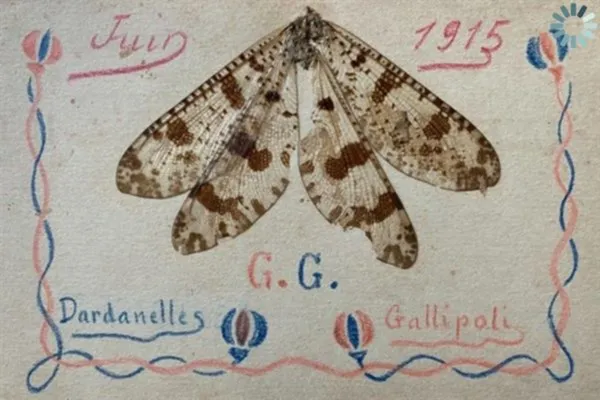
One of the most striking pieces in Bill Sellars' collection is a handmade postcard believed to have been created on the Gallipoli Front in 1915.
The piece, prepared on thin brown paper, features a dried lacewing insect commonly found on the Gallipoli Peninsula, fixed to the paper and surrounded by a carefully decorated frame drawn with colored pencils.
Sellars said Allied soldiers had no access to stationery supplies or shops behind the front lines, and therefore materials such as paper and cardboard were highly valuable. He added that the thin brown paper used in the piece had most likely previously been used to wrap a package before being repurposed and transformed into a small work of art.
The only clue: "Juin"
It is not known who created the card. However, the word ''Juin'', meaning ''June'' in French, written at the top suggests that the piece was most likely created by a French soldier.
Apart from the letters ''G.G'' on the card, there is no visible information about the soldier's identity or the unit in which he served.
Purchased in France and brought back to Gallipoli
The postcard was purchased several years ago at an auction in France by Bill Sellars and his wife, Serpil Karacan Sellars. Thus, the card, which left Çanakkale approximately 111 years ago, returned many years later to the land where it was created.
Considered by historians to carry significance beyond that of a small work of art, the postcard is regarded as one of the rare examples showing how soldiers who fought on the Gallipoli Front tried to reflect their sense of aesthetics, their longing and the geography around them on paper, even under the most difficult conditions.
Eu Day Light
 Facebook
 Tweeter
 Whatsapp